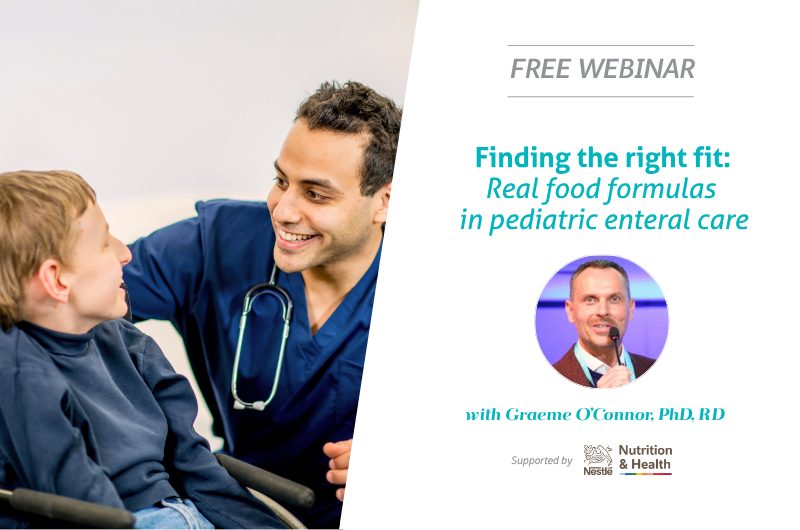
Finding the right fit: Real food formulas in pediatric enteral care
US dietitians:
The CPE activity application for this webinar is pending CDR review and approval for 1.0 CPEUs.
Australian/NZ dietitians:
CPD hours are applicable for Australia and New Zealand dietitians.
Other healthcare professionals:
Check your local country requirements to see if you can claim for continuing education.
About the webinar:
As more families look for feeding options that feel closer to the meals they share at home, dietitians are often the first to field questions about real food-based tube feeding.
Homemade blenderized feeds and commercially available food-based enteral formulas (FBEFs) both bring familiar food ingredients into pediatric care. Finding the right fit often requires consideration of GI tolerance, food safety, practical implementation, and caregiver preference alongside nutrition needs.
Join specialist pediatric dietitian, Graeme O’Connor, PhD, RD, MBDA, to learn how to guide families toward the approach that works best for their child. Informed by the recent international, multidisciplinary expert opinion review, we’ll cover the evidence on FBEFs and how homemade blends and FBEFs compare in day-to-day implementation.
After the webinar, attendees will be able to:
- Understand the key characteristics of real food-based enteral formulas and clinical benefits
- Apply clinical evidence to identify suitable pediatric candidates, initiate and administer real food-based formulas, and set realistic treatment goals
- Differentiate homemade blenderized tube feeding from commercially prepared real food-based formulas in relation to nutritional adequacy, food safety, practicality, and family preferences.
About the speaker:

Dr. Graeme O’Connor is the research lead for dietetics, and the clinical academic careers lead for Great Ormond Street Children’s hospital. He completed his BSc (Hons) in Physiology before commencing a postgraduate degree in Dietetics. He went on to specialize in Pediatric Dietetics and joined Great Ormond Street Hospital for Children in 2008, specializing in eating disorders and Intensive Care.
In 2010 he started a PhD at University College London, Institute of Child Health, investigating energy intake and the refeeding syndrome – the results of this study changed national and European guidelines. Dr. O’Connor’s post-doctoral research includes monitoring gut inflammation in infants with cardiac defects and intestinal microbiomes and short chain fatty acids in oncology and intensive care. He also holds an honorary position at the Institute of Child Health University College London in the department of Infection, Immunity and Inflammation.
Supported by

The content, products and/or services referred to in this session are intended for Health Care Professionals only and are not, and are not intended to be, medical advice, which should be tailored to your individual circumstances. The content is for your information only, and we advise that you exercise your own judgement before deciding to use the information provided. Professional medical advice should be obtained before taking action. Any references to particular products and/or services in this session does not constitute any form of endorsement. Please see here for terms and conditions.
| Continuing Education (USA) | |
|---|---|
| Duration | 1 hour |
| CPEUs Awarded | 1.0 - Pending |
| Performance Indicators | 9.1.1, 9.1.4, 11.3.7, 11.5.2 |